As the world aggressively pivots toward nuclear baseload power to meet decarbonization targets and fuel the massive electricity requirements of artificial intelligence data centres, one nation is quietly solidifying its position as an indispensable player in the global uranium supply chain: Namibia.

The numbers tell a compelling story. In January 2026 alone, uranium emerged as Namibia’s largest exported commodity, accounting for 26.3% of total exports and generating N$3 billion in foreign earnings. This performance cements the country’s status as the world’s third-largest uranium producer, trailing only Kazakhstan and Canada, with the trio collectively supplying over 75% of global output.
But leadership in this market is not merely a function of geology. It is the product of strategic foresight, record-breaking production, aggressive exploration, and a global pricing environment that has finally rewarded patient investment.
Record Production and a Resurgent Giant
Namibia’s ascent to market leadership was underscored by a historic achievement in 2025: the nation topped 10,000 metric tonnes (approximately 22 million pounds) of U₃O₈—commonly known as “yellowcake”—for the first time. This record output has fundamentally reset expectations for what the Namibian uranium sector can deliver.
Central to this production surge is the remarkable resurrection of the Langer Heinrich Mine. Operated by Australian miner Paladin Energy, the mine was placed on care and maintenance in 2018 when uranium prices collapsed. Today, it is on track to complete its ramp-up and reach maximum output by July 2026.
CEO Ian Purdy confirmed the bullish outlook, noting that higher uranium prices are accelerating mining investment across the sector. The resurgence of Langer Heinrich—projected to be the world’s eighth-largest uranium mine by 2026 output, producing approximately 4% of annual global supply—represents one of the mining industry’s most remarkable turnarounds.
Namibia’s producing mines—Rössing, Husab, and Langer Heinrich—are all located in the Erongo Region, a geological sweet spot that now accounts for over 10% of global mined uranium output. The Husab Mine, operated by China General Nuclear Power Group (CGN), is projected to be the world’s third-largest uranium mine in 2026, underscoring the scale of Namibian production.
The Price Environment: Fueling the Next Wave
The resurgence of Namibia’s uranium sector has been powered by a dramatic shift in global pricing dynamics. Spurred by a worldwide push for nuclear energy and looming supply shortfalls, uranium prices surged to a two-year high of $101 per pound in January 2026, before stabilizing in the $85–$90 range.
While spot prices have moderated, the long-term contracting environment has fundamentally improved. Deep Yellow, the developer behind the advanced Tumas Uranium Project, has modeled that at a long-term contract price of US$82.50 per pound, the project would generate a post-tax net present value of approximately US$577 million and an internal rate of return of 19%.
This pricing environment has created a tiered market where Western-aligned production carries a significant premium, as utilities seek to diversify supply chains away from dominant producer Kazakhstan amid geopolitical uncertainties.
The Development Pipeline: Projects Ready to Fire
Beyond the three operating mines, Namibia boasts one of the most advanced uranium development pipelines in the world. The Tumas Project, operated by Deep Yellow, is technically ready for development, with resource and reserve work, engineering, and infrastructure groundwork largely complete.
The project currently hosts a total uranium resource of 118.2 million pounds of U₃O₈ and ore reserves of 79.5 million pounds. Detailed engineering work is more than 65% complete, key contracts have been tendered or awarded, bulk earthworks are in progress, and a Transmission Power Supply Agreement has been executed with NamPower for a dedicated grid connection.
Yet Deep Yellow is taking a disciplined approach. The company has confirmed it will only take a Final Investment Decision (FID) when long-term uranium prices justify construction, rather than relying on short-term spot price strength. This prudent stance reflects a mature industry learning from past boom-and-bust cycles.
Similarly, Bannerman Energy’s Etango-8 project continues to advance, with the company seeing a decision on the new mine in the near term as the pricing environment strengthens.
Exploration Boom: Chasing the Next Major Discovery
The most telling indicator of Namibia’s uranium market leadership is the surge of exploration activity targeting the Erongo Region. In a sign of renewed confidence, Skeleton Coast Uranium has closed a C$5 million (approximately N$95 million) private placement and completed the acquisition of controlling interests in five Exclusive Prospecting Licences (EPLs) covering more than 610 square kilometers .
These licences are strategically positioned either adjacent to or within 10 to 25 kilometers of Namibia’s three existing uranium mines—Rössing, Husab, and Langer Heinrich—putting the company in prime position to discover what could be the country’s next major uranium deposit.
The company has appointed Practara, a South African metals and mining advisory firm, to complete NI 43-101 Technical Reports for all five licences. Work to date has identified exploration targets for both basement-hosted (alaskite) uranium and secondary palaeochannel/calcrete-hosted uranium mineralisation, reflecting the dual geological endowment that makes the Erongo Region so prolific.
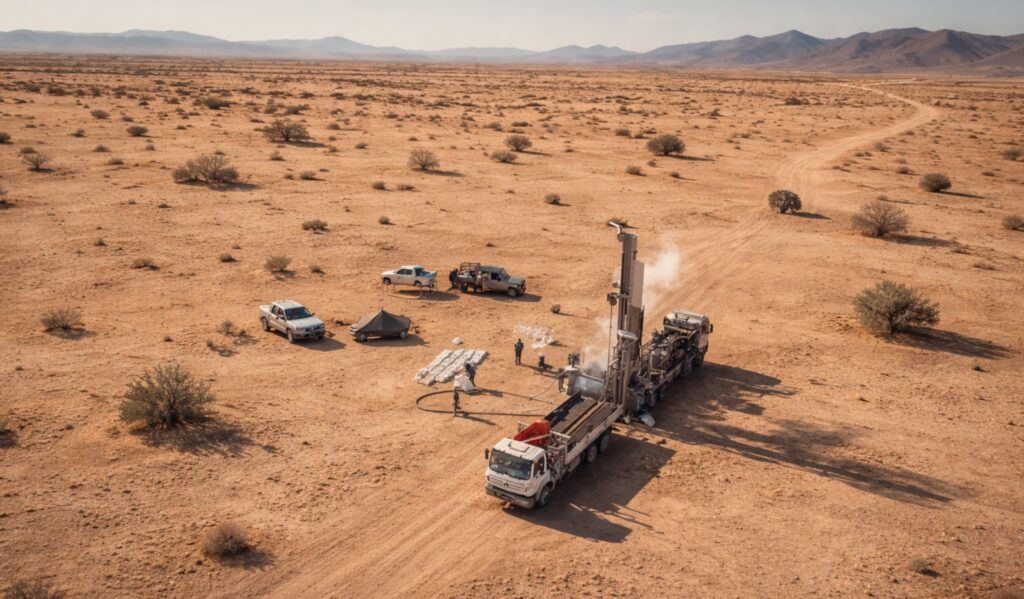
With proceeds funding a 2026 exploration programme including radiometric surveys, gamma ray spectrometry, mapping, and up to 4,000 metres of reverse circulation drilling, Skeleton Coast Uranium exemplifies the “smart money” flowing into Namibian uranium.
Global Demand Drivers: The Nuclear Imperative
The strength of Namibia’s uranium market leadership is ultimately underpinned by unshakeable global demand fundamentals. More than 30 countries have pledged to triple nuclear capacity by 2050, recognizing that intermittent renewables alone cannot deliver decarbonization at scale.
The drivers are two-fold. First, the decarbonization imperative has forced a re-evaluation of nuclear power as a zero-emission baseload source. Second, the explosive growth of artificial intelligence data centres has created unprecedented electricity demand that only nuclear can reliably meet.
This demand outlook is reflected in the projections. The Chamber of Mines of Namibia notes that long-term uranium demand is projected to grow by 28% by 2030. Production cuts by major producers Cameco and Kazatomprom have further tightened the market, creating a structural deficit that Namibian producers are well-positioned to fill.
Strategic Positioning: A Western-Aligned Supplier
Perhaps the most significant development for Namibia’s uranium leadership is its emergence as a preferred supplier to Western utilities. Approximately 80% of Namibia’s 2024 mined production was exported to China, with less than 10% going to the United States. However, this is changing.
The U.S. Department of State and the U.S. Trade and Development Agency (USTDA) have recently expressed interest in working with Namibia to secure uranium supply chains and the infrastructure needed to expand production. This interest reflects a broader strategic realignment as Western nations seek to reduce dependence on Russian and Kazakh supply.
Namibia’s stable political environment, established regulatory framework, and long mining history give it a decisive advantage in this new geopolitical landscape. As one analyst noted, “geopolitics is now a decisive accelerant,” with supply disruptions in traditional resource regions increasing the premium on stable, rule-of-law jurisdictions.
Outlook: Cementing Global Leadership
As 2026 progresses, Namibia’s uranium sector stands at an inflection point. The country has already achieved record production and top-three global ranking. The question now is whether it can translate this momentum into sustained market leadership.
Several factors suggest it can. The Langer Heinrich ramp-up will deliver full capacity by mid-2026, adding meaningful supply to a tight market. The Tumas and Etango-8 projects are poised for FIDs as long-term contracting improves. And the exploration boom led by companies like Skeleton Coast Uranium suggests that new discoveries will replenish the pipeline.
The World Nuclear Association notes that Namibia hosts approximately 5% of the world’s total recoverable uranium resources—a figure that is likely to grow as exploration continues. For a nation that has long relied on diamonds and, increasingly, gold, uranium is emerging as the strategic mineral that could define Namibia’s economic future for decades to come.
As the global nuclear revival accelerates, Namibia is no longer just a junior player in the uranium market. It is a leader—and the world is taking notice.