Namibia – A surge of exploration activity across Namibia is redefining the country’s geological potential, with new discoveries of critical minerals, advanced geophysical surveys, and strategic expansions of gold and uranium projects dominating the sector. From the Damara Belt to the Otavi Mountain Land, juniors and major explorers are deploying cutting-edge technology to uncover the next generation of mineral deposits.

New Critical Mineral Discovery Near Uis
Askari Metals has announced a significant polymetallic discovery at its Uis Project, confirming the presence of five critical metals: tin, lithium, tantalum, rubidium, and caesium . The Australian-listed company’s first-phase trenching programme validated what the company describes as a “high-grade polymetallic critical minerals asset” located directly adjacent to Andrada’s Uis Tin Mine, Namibia’s most advanced tin mining operation.
“Despite sharing the same geology as the nearby Uis tin mine, the potential of the Uis Project to host significant tin and tantalum mineralisation was never a focus in previous exploration or analysis,” said executive director Gino D’Anna . The project benefits from direct access to the Walvis Bay Deepwater Port, less than 230km away by tarred road. Askari intends to use the trenching results to inform renewed drilling operations in the second half of 2026.
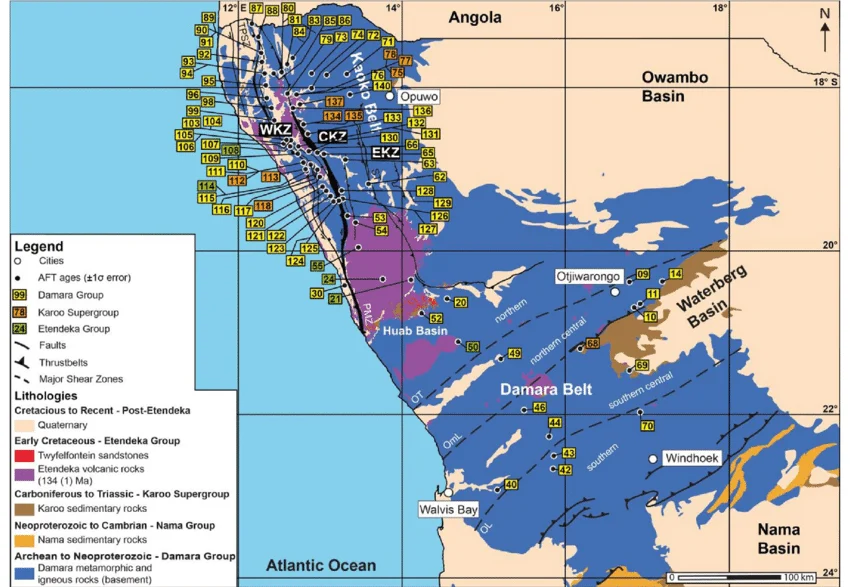
Ongwe Minerals Expands Gold Footprint in Damara Belt
Ongwe Minerals has substantially increased its land position in the highly prospective Northwest Damara Belt, securing a 90% stake in the adjacent EPL7400 licence (36,600ha) at its Omatjete Project and submitting an application for EPL11268 (8,200ha) . The expansion increases the project area by up to 42% and has identified a prospective parallel fault system.
The company now controls 50km of strike on the Okondeka Fault Zone (OFZ), which hosts both WIA Gold’s 2.9Moz Kokoseb deposit and Ongwe’s newly discovered Manga Gold Prospect . A recent in-house structural re-analysis has identified a prospective relay system and the parallel Okakongo Fault Zone within the expanded licence package, giving Ongwe a second 25km-long significant fault system to explore.
Meanwhile, Ongwe has mobilized a reverse circulation (RC) drill rig to commence a 6,000m bedrock sampling campaign at its Belmont Prospect near Khorixas . The campaign—4,000m at Belmont and 2,000m at Manga—aims to outline bedrock gold targets beneath surface calcrete cover, replicating the exploration methodology that led to Osino Resources’ discovery of the 3.1Moz Twin Hills gold deposit. Scout drilling at Belmont in 2024 has already returned proof of high-grade mineralization beneath the surface calcrete, with intercepts including 6m at 6.85g/t Au from 20m .
Terra Minerals Targets Copper-Gold-REE at Project Nantis
Terra Minerals is chasing a multi-commodity discovery at its greenfield Project Nantis (EPL 10464) in the Khorixas District of the Kunene Region. Early rock grab sampling has returned high copper grades up to 13.90% Cu, silver anomalies up to 66 ppm, and unusually elevated cobalt values reaching 5,160 ppm . The company has also detected a rare earth pathfinder suite including niobium, tantalum, zirconium, yttrium, and thorium, consistent with a large mineral system.
The company is now seeking N$16 million to fund an 18-month exploration programme that would advance the project from target generation through drilling to an initial mineral resource estimate . The licence sits within the Northern Zone of the Damara Orogenic Belt, in close proximity to the Belmont gold prospect and the Lofdal heavy rare-earth deposit.
“The identification of a deep new paleochannel has positive implications for the target geology,” the company noted, positioning the project as a potential copper-gold discovery or an additional rare-earth-bearing system in a region already associated with heavy rare earth mineralization .
Golden Deeps Prepares Drilling at Graceland
Golden Deeps is advancing toward its first-phase drilling campaign at the Graceland Critical Metals Prospect in the Otavi Mountain Land, with drilling scheduled for early 2026 following completion of an Induced Polarization-Resistivity (IP) survey . The geophysical programme, being carried out by Terratec, will test down to depths of 300 metres across a 2km-long, 1km-wide mineralized corridor.
Channel sampling at Graceland has already returned exceptional grades, including 47.3% Cu with 7,792 g/t Ag, and 13.8% Cu with 171 g/t Ag and 224 g/t Ge . The project targets “Tsumeb-style” Cu-Ag-Zn-Pb-Ge sulphide systems, referencing the legendary Tsumeb deposit which produced 27 Mt grading 4.3% Cu over its mine life. Golden Deeps holds six Exclusive Prospecting Licences covering approximately 440 km² in the Otavi Mountain Land.
Uranium Exploration Advances: Warmbad and Erongo
Pioneer Lithium is pressing ahead with exploration at its Warmbad Uranium Project in southern Namibia, with drilling scheduled to begin in the first half of 2026 . The company has received strong support from local authorities and landowners following a ground reconnaissance visit. The project, an alaskite-hosted uranium system comparable to the Rössing Mine, carries a JORC-compliant Exploration Target estimated between 22.2 and 32.1 million tonnes grading 100 to 120 ppm U₃O₈, based on more than 30,000 metres of historical drilling data.
In the Erongo Region, Arkle Resources has completed airborne and ground-based geophysical surveys across its four uranium exploration licences covering 540 km² . Xcalibur Smart Mapping completed a high-resolution magnetic and radiometric survey of 12,376 line-km at 50m line spacing—four times tighter than 1970s government datasets. Initial horizontal loop electromagnetic (HLEM) survey results have confirmed a well-developed paleochannel in the northeast of EPL 8995 and identified a new paleochannel in the central area reaching depths of up to 17 metres.
Arkle has also located 95 historical drill holes suitable for downhole gamma logging and plans up to 4,000 metres of RC drilling in the second half of 2026 . The company’s licences are contiguous to major uranium deposits including Trekkopje, Marenica, and the world-class Rössing mine.
Cutting-Edge Technology: Drone and Satellite Mapping
A recent study by the Helmholtz-Zentrum Dresden-Rossendorf (HZDR) has demonstrated the effectiveness of combining drone-borne and satellite hyperspectral imaging for non-invasive mineral exploration in Namibia . The research, presented at the Society of Economic Geologists Conference in Windhoek, showcased this approach at two Namibian sites: the Marinkas Quellen Carbonatite Complex and the Uis pegmatite-hosted tin mine—both hosting critical raw materials including rare earth elements and lithium.
The vertical integration approach combines high-resolution drone imagery with 30m ground sampling from satellites such as EnMAP, PRISMA, and the soon-to-be-launched Planet Tanager and CHIME missions. This methodology allows for fast, systematic identification of key minerals at surface while minimizing environmental impact—an increasingly important consideration for stakeholder acceptance.
Structural Trends and District-Scale Potential
What unites these diverse exploration campaigns is a growing recognition of Namibia’s district-scale potential. The Northwest Damara Belt, largely unexplored due to extensive calcrete and wind-blown sand cover, is emerging as a major gold province following the discovery of Twin Hills and Kokoseb . Ongwe’s systematic approach—using geophysics, innovative sampling, and bedrock drilling to penetrate cover—is being replicated across multiple commodities.
Similarly, the Otavi Mountain Land’s potential for Tsumeb-style polymetallic deposits is being re-evaluated with modern geophysical techniques, while uranium exploration in the Erongo and Warmbad districts continues to benefit from high-resolution airborne surveys and reinterpretation of historical datasets.
As one exploration executive noted, “The extensive cover has led previous companies to consider these parts unexplorable—but we now have the tools to see through it” . With drilling campaigns scheduled throughout 2026 across gold, uranium, copper, and critical minerals projects, Namibia’s exploration pipeline is poised for what could be a transformative year of discovery.